Posted in Books, Preparing for Kindergarten

Camouflage – Snow Rabbit, Spring Rabbit

It was one of those really long, but good days.  I want to just curl up and go to bed but I thought I should post about our book today.

Our next book from the “Kindergarten Ready, Set Go!” calendar was Snow Rabbit, Spring Rabbit: A Book of Changing Seasons by Il Sung Na.  I read this book to my Kindergarten class back in March as a diagnostic task for assessing their ability to Make Connections.  After studying signs off Fall and our unit on migration in November I wanted to see they  could connect with this book and how the different animals know that it is time for winter.   After that activity I put in on the shelf but pulled it out today to read to Eileen and my niece who is visiting for a couple of days.
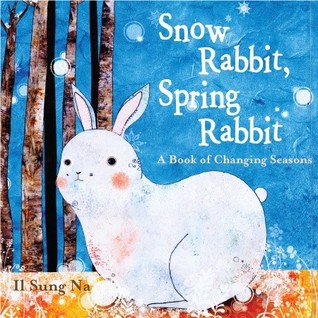
Since it is not really a time of year when they can relate to changing seasons, just VERY warm dry weather, I decided to focus on a different aspect of the book.  The rabbit in the book know it is time to change the season and changes the colour of it’s coat.  We talked about why he might change his colour, and with some prompting we figured out that he might want to be able to hide.  In the winter with a white coat, he can hide in the snow but that wouldn’t work very well in the spring so he changes his colour to blend into different surroundings.

I then sent the girls on a hunt to each find 3 stuffed animals in our ‘stuffy bin’ that they could hide outside.  I talked about how we would want them to blend in with their environment.  They really didn’t understand this at all but had fun playing find the stuffy.  I was glad I picked 2 to hide so that it was bit harder for them to find.

They didn’t quite understand the hiding concept and I found them just laying on the grass.  It was kind of funny that Lyric hid her first and then Eileen pretty much just went and put them in the same spot.

I thought that I hid mine in places a bit more difficult to find but I also was more strategic picking what animals to use.
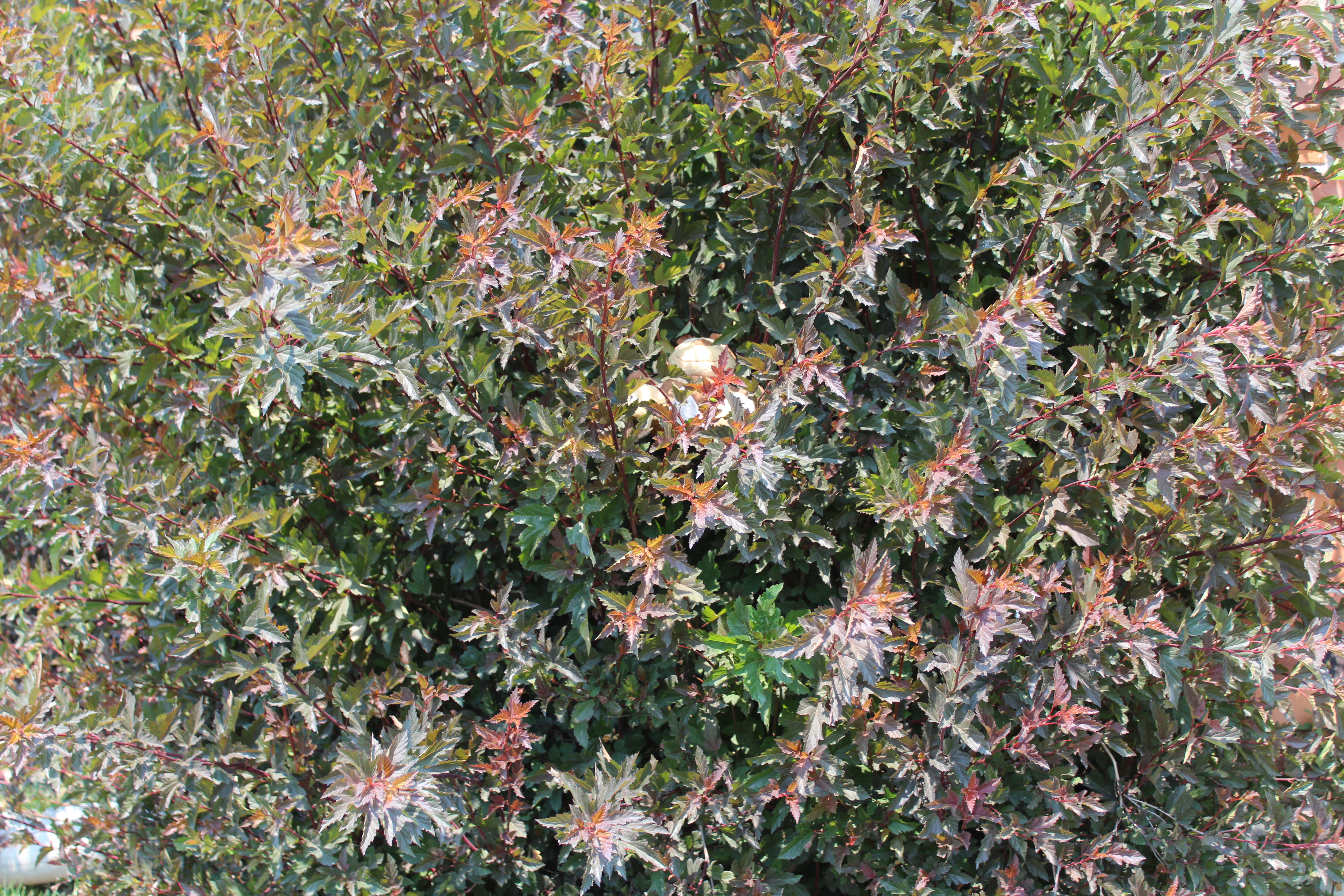
They found the hummingbird pretty easy but needed a lot of guidance to find the brown monkey in the bush – can you find it?

Even though the girls didn’t understand the purpose of the game or really understand camouflage at all we had fun.  If I was to do this again, after reading the book I would show them some images of real animals and how they use their colours to camouflage.  Then I would give them toy animals to hid that they would be able to blend into their environment.  For example they may have had more luck with the green turtle.

After playing we went on a search for some very special twigs and then took them back in to the air conditioned house.  I told them we were going to make our own animals that we would then later hide for Kaitlyn to try and find outside.  I got out the goggly eyes, pipe cleaners, white glue and a bit of gold glitter glue.  We made our own creatures out of our sticks, and the two pinecones the girls just had to use.  I found my inspiration at KinderNature.
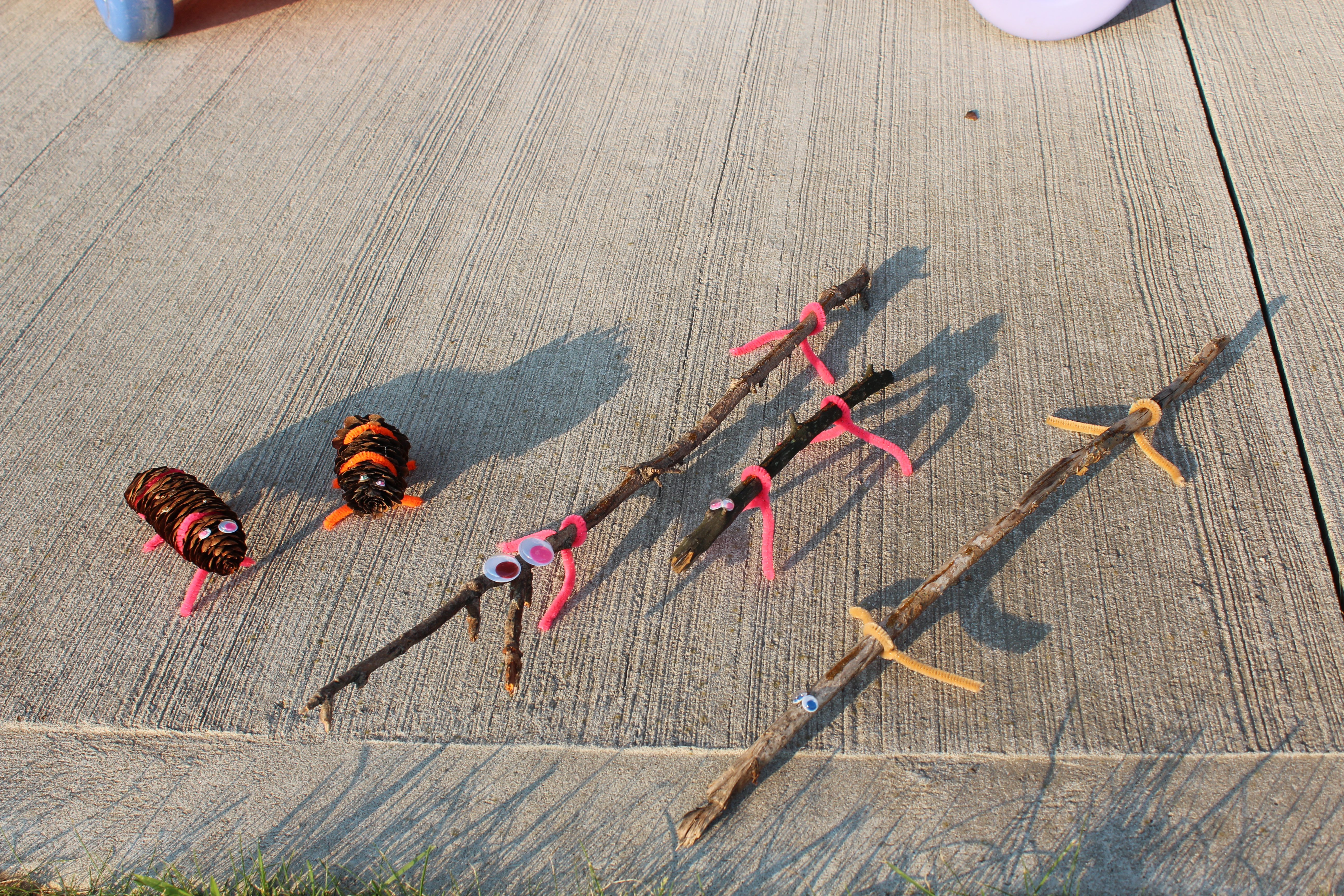
They are a bit more camouflaged but the urge for the girls to pick bright colours for their legs won out (mine is the one with the brown legs).  We didn’t have time to hide them for Kailtyn today but we will make sure we do it sometime this weekend before my nieces go home!

Posted in Literacy Tuesdays

A Giant Curve

“Mommy, A Giant Curve!”

Eileen and I have been doing the Handwriting without Tears Get Set for School program for about a week.  In the HWT program there are three types of shapes that are very important: big line, little line, big curve and little curve.  Today when we were at Grandma and Grandpa’s Eileen came running up to show me what she found!  Very cool!

Posted in Professional Development

Teaching in the Digital Age – Chapter 2

Chapter 2 is on using photographs and images to inspire in the classroom.  I already take a lot of photos with my class so I was interested to read this chapter.  I knew in advance that the biggest difference was going to be that currently I am the one using the photographs but I need to get my class involved in interacting with images.  I was pretty successful in using Evernote to take notes on this chapter so I am referring to it to write this post.  It would be cool if I could find a way to import into wordpress from Evernote but I think that may be asking too much.

As with all my reading I am constantly trying to find ways to incorporate different methods and teaching styles into the new Full Day Early Learning Kindergarten Program (ELK) that I will be starting in September.  The first thing that struck me was to use photos to encourage questioning and our infamous ‘I Wonder’ questions.  With our inquiry based learning class students are to drive the learning but before they can ask inquiry questions they need to know how to question.  Sometimes they know what they want to learn but they have trouble articulating it out loud.  Images would be an excellent way to model questioning!  I can see starting the day with a picture on the Smart Board that the class can see as they arrive in the morning.  I would first just let them approach and view it on their own.  Once we meet on the carpet I would ask them if they have any questions about the image and record them around the image.  Near the beginning of the year I may need to do a fair bit of modelling as to what questions I may come up with but  I would hope it wouldn’t take them too long to come up with great questions independently!  This could provide spin off ideas during learning centres – story writing, research, drawing, etc.

The next idea that would work great in my ELK class is using photos to develop background knowledge when developing dramatic play centres.  This is a great way to incorporate learning into playing and the children would never question having to do the work to help set up the centre.  In the book they disussed making an Australia centre., but you could use the same strategies for any type of dramatic centre.  Last year I did a unit on space and gave the students a large fridge box to make a spaceship.  They had a great time but would have gotten so much more out of it if we would have first explored photos of other spaceships and what parts they might want to put on theirs.

One of the big initiative in Ontario are TLCPs – Teaching-Learning Critical Pathways.  This is a model of how we plan and run a critical thinking/comprehension area of our language program.  Sometimes in Kindergarten we find this model difficult to run as our students are at very beginning levels of literacy.  We cover different expectations throughout the year but at our school the one area we are always focusing on is making connections – text to self, text to text, and text to world.  After reading chapter 2 I was starting to think that we could use digital images to help our students make connections.  Peurling writes that people take photographs to capture moments in life and “When this happens, people engage in familiar discussions about people, events and stories associated with memories”.  The key for our Kindergarten students to have them connect their memories and experiences.  For example, if we were reading a number of books on winter  then I could show them a picture of a winter scene similar to the one Puerling showed his class of the Chicago blizzard.  They could make connections to events that they have experienced or books we have read.  I would do this by putting my playbook beside me and recording their observations as they looked at the photos. Then I would have a record of their thought and also any prompts I had to use.

A couple of other areas that I found very interesting in the chapter included using pictures to teach emotions and self-regulation, using photos to create anchor charts for behaviour at centres, and illustrating book similar to Mo Willems’ Knuffle Bunny.

Finally the main thing I got from this chapter is that I need to figure out a way to get the camera out of my hands and into the hands of my students.  I am not sure how to get this to happen with our expensive school cameras but I need to figure out a way!

I will link to the Blog party at Dr. Jean‘s site but I wanted to mention to make sure to check out her post if you aren’t finding me from the link.  I love ALL of the amazing activities she has listed.  I so want to make the books with my class!  One of my goals for next year is for us to make more cooperative class books.  ‘Welcome to our Room’ would be great to use at the beginning of the year to help students become familiar with their classmates and to recognize their names.  I want to do this before Meet the Teacher Night!!  I also love the ‘Alphabet in my Mouth’ book at it would be great to make to celebrate with my JKs after we are done our Jolly Phonics letters.

Posted in Books

Everything I Need to Know Before I’m Five

It is summer time and that means more frequent trip to our local public library.  Last week I took Michael and Eileen to the launch of the summer program and told them they could both pick out a few books to borrow.  Michael randomly picked a board book and Eileen came back with 4 picture books.  They all looked pretty cool but I don’t know if there was much method behind her selections.

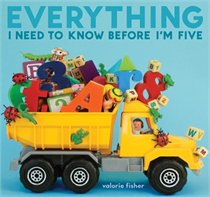
Tonight we read Everything I Need to Know Before I’m Five by Valorie Fisher.  This is not what I would call a prime Read Aloud but it is a cool book none the less.  The title pretty much gives it away, this book is a a series of pages introducing the concepts of numbers, opposites, shapes, colours, seasons, weather, and the alphabet.   As a Kindergarten teach I would have to say it is pretty much the basic rote information a child learns in JK.  In school there is much more that they learn in terms of comprehension, social skills and critical thinking but for the things that just need to be memorized this book pretty much covers it!  The illustrations are bright and simple photographs appropriate for the under 5 crowd.  Michael loved pointing to things he recognized as we read along.

This is a book I definitely want to get for the concept book section of my classroom library.  I can see many of my students spending lots of time going through the pages quizzing each other and reinforcing their knowledge.  A cute idea for a book!

Posted in Books, Preparing for Kindergarten

Black All Around

Our next book in the 2012-2013 Kindergarten Ready Set Go Calendary was Black all Around written by Patricia Hubbell and illustrated by Don Tate.  The girls have really enjoyed making their movies so I thought I would expand on that.  I gave them my iPhone and sent them on a hunt throughout the house to find items the colour black.  They love taking pictures on my phone so this wasn’t much of a request.  We then downloaded them to the computer, decided which ones needed retakes, and made a quick slideshow using iPhoto.  They helped me create the opening and closing slides.  Everyone was tired today so I did most of the picture cropping but I think this is something Kaitlyn is almost old enough to do herself.  Voila!

These activities are to help prepare Eileen for Kindergarten and this one was great for colour practice but I got some good ideas for Kaitlyn out of this exercise.  Some of the photos were not great so in 1 minute I talked to her about staging the items and holding the camera/phone very still – her retakes were a huge improvement. I am thinking she may almost be ready for her own camera – or maybe even just giving her my old camera.      It needs to be fixed but I may take it in and if it doesn’t cost too much I think she would love it.  Then we can start to teach her how to use a camera properly and I am pretty sure that soon enough she will be taking better pictures than me!

Posted in Books, Cooking with the Kiddies, Craft Thursdays, Literacy Tuesdays

5 Little Ducks, a Donkey and a Wolf – MeMe Tales Readathon Week #1

I was very excited to learn about the MeMe tales readathon and we downloaded the app and the first books a couple of weeks ago.  However, as school had not finished yet we are a couple of weeks behind.

Week 1 of the Readathon was all about Animals.  We have tonnes of animal books at home but it was cool that both of the books for the readathon were traditional tales.  I am been trying to introduce the kids to nursery rhymes and fairy tales so this fit in perfectly.

We started with 5 Little Ducks.

The Five Little Ducklings
memetales logo

The Five Little Ducklings

See more at memetales

This is a familiar tale and instantly my girls started to sing the song.  I went to iTunes and downloaded them the Raffi version.  They listened to it over and over again and then decided that they were going to act it out for themselves.  I sent them on a hunt to find as many toy ducks as they could.  Michael’s favourite toy is his stuffed duckie but we managed to find a bunch more, especially when we got into the bath toys!  We used two large pillows covered by my green table cloth for the hill (they called it the mountain), and we filmed in the backyard on a sunny day.  It took a bit of rehearsing and distracting of one little brother but it ended up pretty cute!

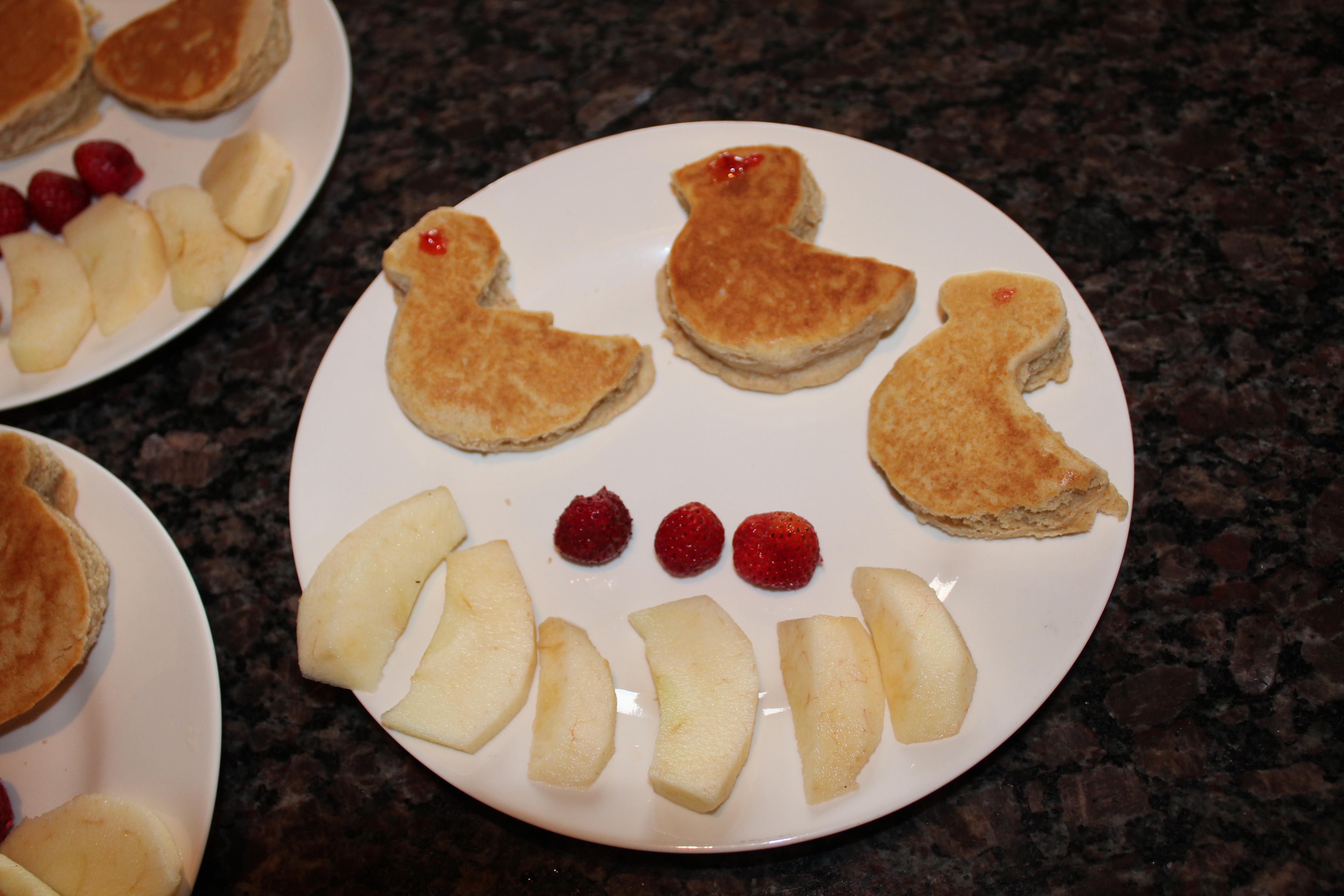
I got inspired to create a special breakfast for the girls around the duck theme. I found a gluten free pancake mix in the pantry and decided pancakes and fruit would be perfect.   The only problem was that most of my cool shaped cookie cutters are plastic.  I found a tutorial at Time 2 Save that helped me use tinfoil to copy my pastic duck cookie cutters.  This was supper easy and let me make duck shaped pancakes for breakfast.  They asked why they didn’t have 5 ducks each but I am glad I didn’t make that many – they each ate only 2!

Continue reading “5 Little Ducks, a Donkey and a Wolf – MeMe Tales Readathon Week #1”

Posted in Books, Professional Development

Teaching in the Digital Age – Blog Party (Chapter 1)

I had been waiting to see what the book was going to be for the pre-K/K blog party this year and  was excited to hear it was selected to be: Teaching in the Digital Age by Brian Puerling.  I like to thing that I am techie but I am always striving to find developmentally appropriate ways to use technology in my JK/SK classroom.  This past year I found that 75% of the time I was the one using the technology and my class were simply passively observing.  The only times they were engaged is when we were using the Smartboard but even then there was very little critical thinking taking place. I am starting the book study a bit late for a couple of reasons.  First it took a month for my book to come in – it was on back order.   Also in Canada we don’t finish school until the end of June so I didn’t have time to crack my book open until school ended.  Now that school is finished and I am starting to feel relaxed I am catching up on my reading!

I started by reading the introduction and chapter 1.   I love how it is written very simply.  I find too often I am reading education texts that I first have to think about decoding the vocabulary and it takes a bit more concentration to understand the deeper meaning.  It is summer and as a rule I don’t want to have to think too hard about anything!  Before I even got to chapter 1 I started to take advantage of the QR codes and I downloaded a QR code reader on my iPhone – I don’t know why I hadn’t done this earlier, it is so cool!  As an aside I also downloaded one on my new playbook but I can’t get it to work.  I especially like how it points out what should be obvious to me but I need to think about.  For example it talks about getting media consent.  I never post any pictures or names of my students on the web but this is something I need to figure out for September.  I would love to have a closed website/blog that parents can view with a password and then I can post student pictures and videos.  I need to figure this out.  With the new ELK program we are starting in September many of our assessments and observations will be done on my new playbook through a lot of pictures and videos I would love to be able to have the students use this material more interactively and also share it with student’s families.  That is one of the things I am hoping to get out of this book.

Chapter 1 is entitled “The Digital Classroom”.  This immediately reminded me of David Warlick’s Redefining Literacy for the 21st Century.  This was a great book I used when I use to run the school library but many of the strategies I found too difficult an abstract for my kinders.  Often the limiting factor is a requirement of basic literacy: reading and writing.

In chapter 1 Puerling discusses the world our students are experiencing inside and outside of the classroom.  As a parent I immediately thought of my own children.

This is not an unusual sight – to see all three of my kids sitting around the iPad.  What is more common is to see one on the iPad, one on my iPhone and one on the computer.  My youngest, Michael is very adept at using the iPad and can easily find his favourite apps (he is not 2 years old yet).  Now don’t worry my kids aren’t on technology all day.  Often they play a bit in the morning while they are still waking up and then maybe a bit in the afternoon on a really hot day, like we have had all week, when it is just too hot to go outside.  When they are not on technology they are usually dancing (to the same songs over and over again) or doing crafts.  But I digress …

The reason I mention my kids is because I feel they are not indicative of the population we live in.  Last year I set up a symbaloo site for my class to use at home and very few actually did.  I want to set up a class website/blog but I am not sure how many families may actually use it.  A few families in my class don’t have internet at home and of those that do some are still on dial-up.  Our county is expanding broadband to the more rural areas but this process is slow and frustrating.  This does not mean that I shouldn’t use the technologies in my class but it means that I need to be aware that my students will come with varying levels of background experience.

The key is to marry the use of technology with my play based classroom.  I love Bonnie Blagojevic’s comment that we need to: “Use technology to enrich, not replace, hands-on learning experiences so important to young children”.  We don’t use the technology to teach the technology but rather as a tool to learning.  If we keep this in the forefront of our minds I believe both teachers and students will be successful!

Take away from this chapter:

  • Check out the forms at the back of the chapter.  I may not be able to use all with the new way of planning in the ELK program but they will help me get organized.
  • I want a document camera!  After they were mentioned I looked them up and one would be awesome to use in my class.  We could use it to share the awesome work students will be doing and exploring in our inquiry based class.  Think how we can share the items my students bring in from the natural world!
  • Use my Evernote!  This is one of my goals for the summer.  Come September I am hoping to use Evernote to record assessments of my students (using my new Playbook) and why not start now.  I hadn’t thought of it until Karen on Pre-Kinders commented on using Evernote to record comments so I am going to try it with chapter 2.
Posted in Books

Little Book Adventure – Challenge #3 A Spineless Book

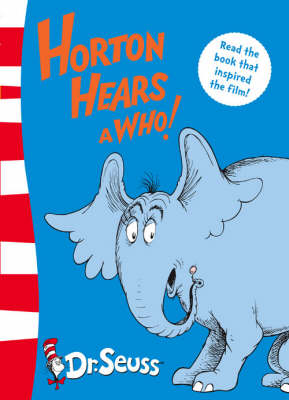
For challenge #3 we decided upon the Dr. Seuss classic Horton Hears a Who! This past April completed a Dr. Seuss unit with my Kinderoos and this is a book I didn’t have a chance to sad with them.  Kaitlyn also got a number of Dr. Seuss books a few Christmas’ ago and this one we hadn’t looked at much.  I had seen the movie on Netflix a while ago but it isn’t there now so we ended up purchasing the film from iTunes.

We started by reading the book together.  Kaitlyn had already seen the film at school but she didn’t remember much.  Next they watched the film (I watched most of it with them but missed part putting Michael down for a nap).  We didn’t have time to do much follow up so again today the kids watched the film and revisited the book.  Next we went through the 6 guiding questions, and most of the answers are from Kaitlyn.

Did the characters look the same as in the book?

The Who’s looked different, especially their hair.  The Kangaroo also had different hair (she seemed fixated on everyones hair).  After some prompting she did say that the characters were different colours.  Our classic Dr. Seuss book has only white, black, blue and red so this is a pretty big difference.  Finally she said the clover in the movie was purple as opposed to red in the book.  On further investigation the clover is more pink in the movie and red in the book.

Did the characters speak the way you imagined?

This is a great question and one I often think about when seeing movie adaptations but I think it is a bit to abstract for my children.  Kaitlyn’s quick answer was yes.  I always find that when I watch films the accents sometimes throw me off!

What parts of the story were left out of the film? Were there any extra parts in the film?

This is interesting because often in adult adaptations much has to be left out due to time but when adapting a children’s picture book the reverse often happens and more has to be added to increase the length.  Kaitlyn’s biggest worry was that  there was no snow in the book but there was in the film.  She also came up with on her own that the cage they held Horton in was different.  I found it interesting that she focused on the small details and missed some of the bigger differences. For starters there are a lot more characters in the film and one main character was changed.  In the book JoJo is a little Who with no connection to other characters but in the film he is the mayor’s only son (and he as A LOT of daughters).  She did come up with this with some suggesting but still seemed focused on the small details.  The thing that struck me was that in the film Horton had an ultimate destination and was trying to get the clover up to the flower to protect it but in the book he was just trying to protect it without having a specific plan.

What did you like about the film?

The song at the end.  My girls are obsessed with the song Can’t Fight this Feeling at the end of the film. If anyone knows where I can get a copy of this version please let me know.  I played the REO Speedwagon version and even the GLEE version for them but they really want the Horton version.

What didn’t you like about the film?

That the Mommy Kangaroo didn’t believe Horton.  In both versions the Kangaroo didn’t believe Horton but it seemed much more exaggerated in the film – especially after the Who’s are heard by everyone else.

What did you like better – the book or the film? Why?

The Film – because of the song (I should have seen that answer coming).

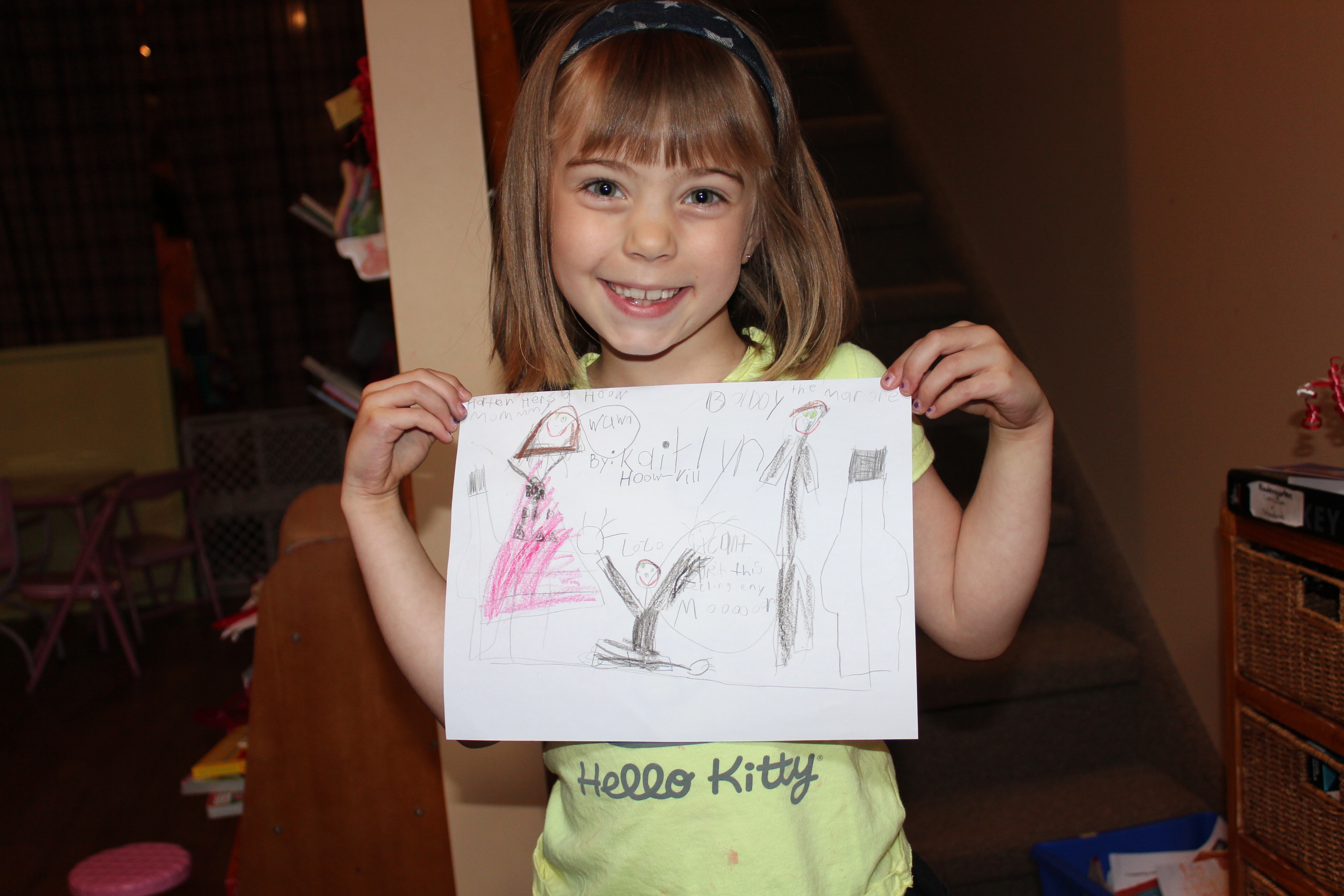
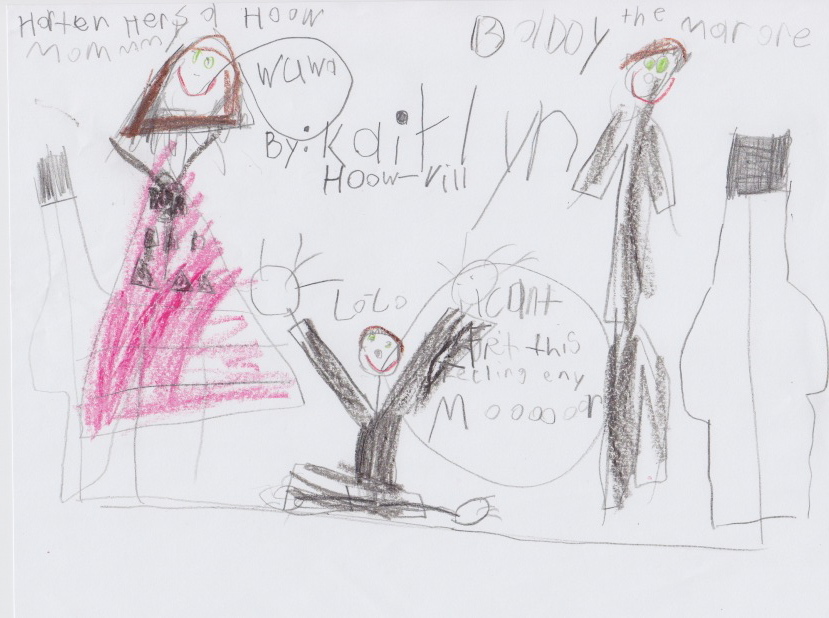
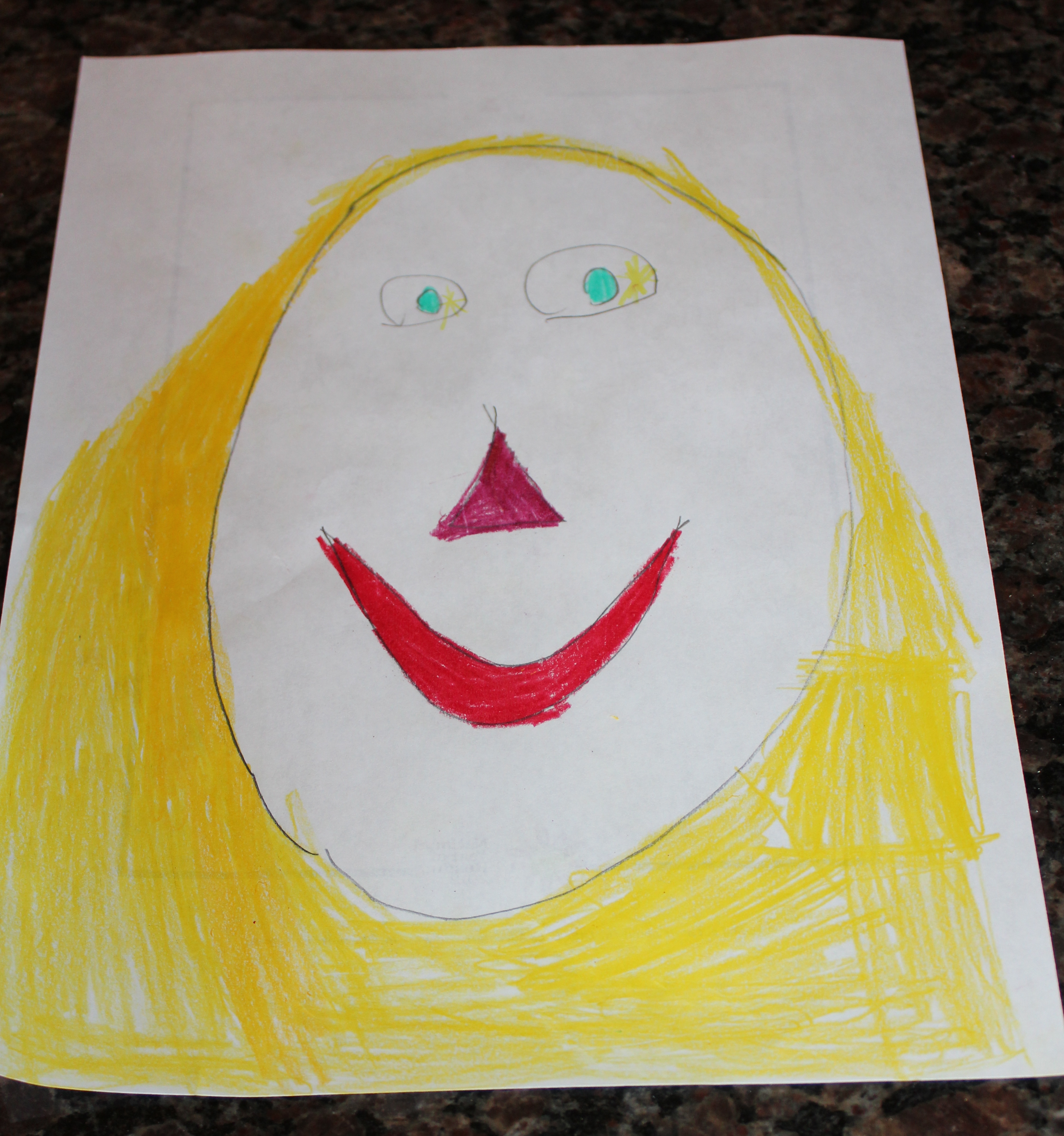
Kaitlyn drew a picture of her favourite part to share.  It you read carefully it is Mommy and Daddy Who with JoJo in the middle singing “I Can’t Fight this Feeling Anymore”.

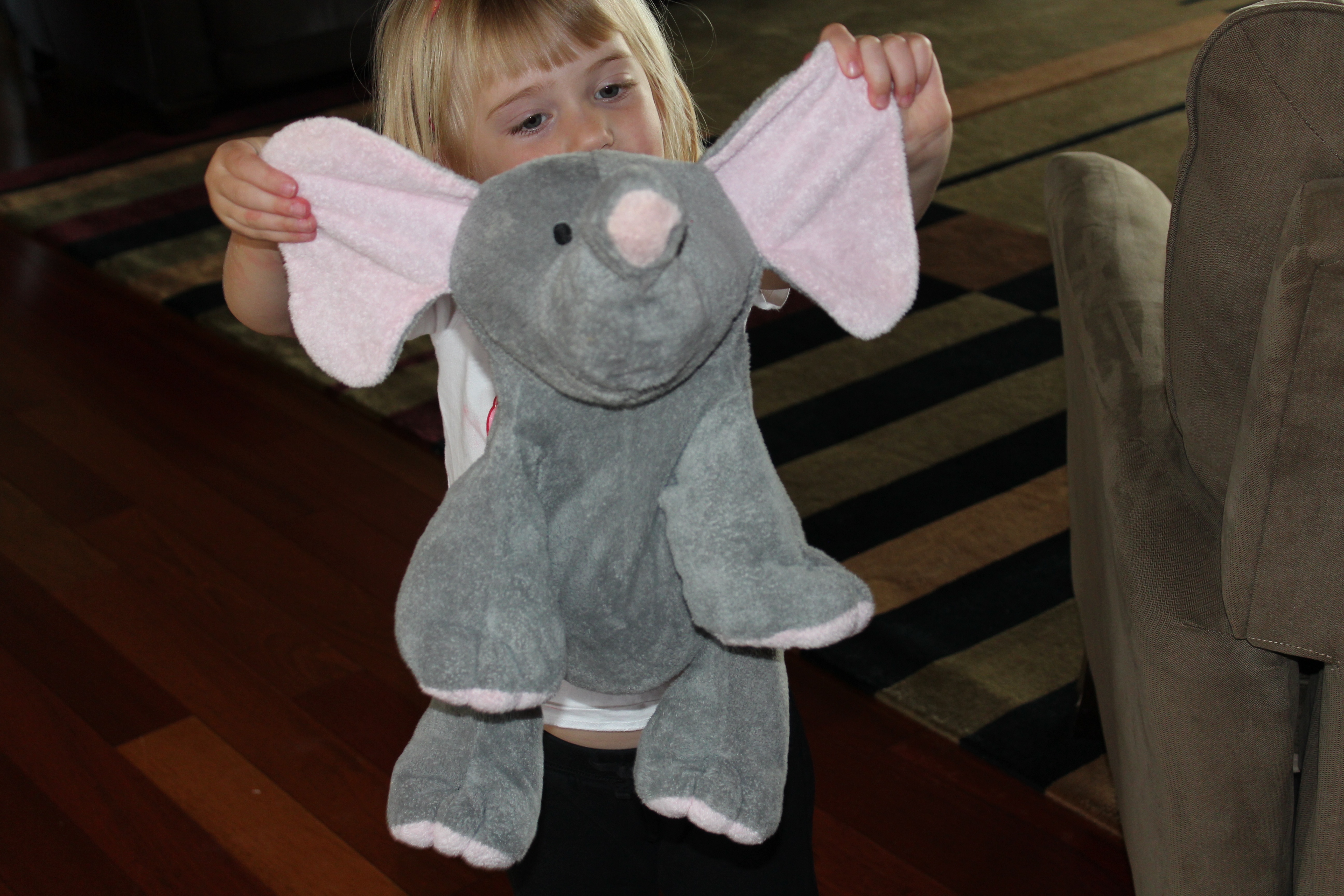
Eileen was more interested in renaming one of Michael’s stuffed elephants Horton (he seems to have a fair number) and running around the house pretending to get away from the other animals.  It was quiet cute and her way of retelling the story!

Posted in Books

Little Book Adventure – Challenge #2

So we are way behind on everything!  It is the long weekend and we have been working hard outside but had to come inside while Daddy was cutting the grass.  Eileen asked to do a craft, and not just a craft in the basement but a ‘Mommy craft’ upstairs in the kitchen.  I figured this was a great chance to do one of the many things we have been trying to get through.  We decided to tackle challenge #2 from the Little Book Adventure.  This was the challenge from April but it’s better late than never.

We started by reading Surprise by Karen Andrews.  I had ordered this book back at the beginning of April and hadn’t had a chance to read it to the girls yet – it is awesome and I would recommend it to anyone (international shipping wasn’t even too bad).  It is the story of a number of children who each sign out the same library book and find a surprise picture from the previous reader  – a cool idea.

The girls each picked one of their library books we signed out last week and I read it to them.  Then I printed off the letterhead for the challenge and wrote a note at the bottom so that the parent or librarian who sees the picture will know what it is.  I am pretty sure not many people in our small town will be participating in the Litte Book Adventure so I wanted to make sure the reader understood what the picture is.  I also placed the link to this blog so if you are visited because you saw our pictures we would love for you to comment!

Kaitlyn picked Dr. Seuss’s The Lorax because she loves it and thought it would have the greatest chance of being signed out by another person.  The challenge said to write a letter to the next reader but Kaitlyn really wanted to draw a picture so we did both!  I helped her with spelling a few words but she did most of it herself.  I love how she thought to looking the book to spell Truffula.  On the other side she drew a smiling picture because she was happy the little boy was planting the seed.  I told her she could draw anything but she wanted to draw a smile because in Surprise the kids drew pictures of how they felt.


Eileen chose Crocodiles Play by Robert Heidbreder.  This was Blue Spruce nominee from a few years ago.  She needed a bit more help so I helped her with her letter.  She started by saying she wanted to draw a picture of a crocodile but then came to the conclusion that it looked more like a person and changed it to a picture of her family.  I am so excited that her people are starting to look like people.  She has made huge progress with her fine motor skills in the past couple of months.  She even signed her own name at the bottom of her letter!!


This was a quick and easy challenge.  I and looking forward to seeing what Challenge #3 will is?

Posted in Books, Preparing for Kindergarten

Best Babysitter

The next book on our “Getting Ready for Kindergarten” list was Froggy’s Best Babysitter by Jonathan London and illustrated by Frank Remkiewicz.  This would be a great book for teaching concepts of print, styles of text or even onomatopeia but we decided to continue making connections.  This worked very well for us because a favourite movie of ours lately has been Mary Poppins.  Last time we watched it I made sure to point out the part at the beginning when Michael and Jane are reading their father their own advertisement for their new nanny.  After reading the book today I challenged my children to come up with their own qualification for their “Best Babysitter”.  We decided to share their ideas in a movie.